Sunday, 6 July 2025

Interaction Design for Livestream Performance

One of the great joys of my work - which spans educational games, alternative controllers, and playable stage shows - is I’m constantly coming across new ways audiences will approach a piece of technology. The more I explore the more I find myself revisiting the same the same key design questions. In particular, how does my work create a space where users are ready to interact with it?

Put yourself in the mind of your user. What’s the first question you need to answer? The most obvious answer is what do I do? 

But think again. What do I do presupposes that the user already knows that there is something to be done. Perhaps the user doesn’t even know that there’s something that can be interacted with. Even if they did, they may not even know why they'd want to interact with it at all.

Designing for interactions is not just about conveying information. It's about constructing meaning, providing context, and provoking emotions.

How does the user believe the interactive space already works?

What does the user want out of interacting?

What is the user afraid of?

Codex Bash at the Wellcome Collection, 2015

To give an example, in Codex Bash - a game built for exhibitions and museums - most users don’t know the game is there until they start playing it by accident. 

In a video game exhibition, pressing a big colourful button is usually encouraged. So each of my big colourful buttons triggers the start of the game, ready to be pressed by an unwitting passer-by. With one press the game springs to life with colour and sound, displaying a puzzle so trivial it would be impolite not to complete it.

Once this has been solved, the player is an active headspace, willing to participate. Buoyed by success in a simple first puzzle they're emotionally prepared for the more complex challenges the game begins to throw at them. 

The Book Ritual at GDC San Francisco, 2019

In The Book Ritual - a game where I invite players to shred a physical book - players are often afraid to deface a book. Defacing books is quite the taboo, especially in public.

So how can I assuage this fear? I sit the game among the mess and clutter left behind by the others who have come and shredded books before you. It's less intimidating to shred a book knowing that you will not be the first person to do it.


Interaction Design in Artholomew Video’s Reading Challenge

In this article I will take one of my interactive Twitch streams, and pick apart the user experience (UX) decisions that went into making a great show for viewers. Even in an environment where the only interaction the players have is to type into Twitch’s chat feature, there’s a surprising amount to be understood to allow for great interactivity.


Let’s have a look at one of my signature livestream games. This is the Reading Challenge segment from Artholomew Video’s Stream Challenge. Artholomew Video is a livestream video game collection I designed to get streamers and their viewers being creative together. It won the grand prize at the Creative Gaming Awards in Hamburg in 2022.

Tuesday, 12 November 2024

A Clown Theory of Games

I’m working on a playable clown show.

If it all comes together this will be my fourth interactive stage show. Looking at my creative output over the past few years, it's pretty obvious: the interactive stage show has become a bit of an obsession!

In 2016 I debuted The Incredible Playable Show, made up of alternative-controller games designed for the stage. In 2018 I created The Scrambled Eggman Show, a gameshow with challenges made by hacking Sonic the Hedgehog games. In 2022 I reworked my livestream performances into The Crowd Creativity Show, a suite of performance art bits where the audience directs me in creative acts.

I’ve been developing games for well over 20 years now, and it’s been my line of work since 2010. I joined my first clown class in 2018, to help me become a better showman, and honestly it’s transformed my approach.

While I’m still very much a game developer, in practice and at heart, the stage has become a creative home. Nowhere have I felt quite as at-home as in the world of clown.

Me as my clown character, Mademoiselle Cafetière
Photo by Filiz Moore, taken at Scritch Cabaret

The clown is the antithesis to the video game. Where the game is defined by rules, the clown is lawless, driven by impulse, emotion and imagination. Where the game designer values immersion in a world, the clown acknowledges the artifice of the stage. Where the gamer seeks mastery, the clown revels in failure.

In a game every element is strictly defined. For the clown, a stick can be a sword one minute and a walking cane the next.

Nevertheless, for some reason I keep coming back to the computer. There’s something that the rules and the strictness of the machine offer which pairs well with the freeform nature of clown. So much so that it makes a juicy double-act.

That’s why I’m making a playable clown show.


What is clown?


My introduction to clown was with Holly Stoppit. Holly is a Bristol-based clown who is not just a performer but also a qualified drama therapist. As well as running drama workshops for theatre practitioners, she also uses clown as a therapeutic approach for adults with mental health issues. It’s a connection that makes sense, as Holly’s approach to clown is very much grounded in mindfulness. Classes typically begin with a meditation. Reaching the headspace of the clown comes from being present and deeply aware of your sensations and emotions.

Holly Stoppit explaining clown and connection at TEDx Bristol

Every clown will have a different answer to the question of “what is a clown,” but for me it’s always been defined by the headspace Holly helped us find: the clown sees the world as if for the very first time.

The clown is curious, the clown is playful, the clown is open, and the clown is unaware of existing social rules. The clown acts on impulse. Your clown is who you would be if there is no expectation of who you are supposed to be.

In talks I demonstrate this with a paintbrush. As an adult, I know how to use a paintbrush: you dip it in paint and use it to spread that paint on a canvas. To the clown, it’s a totally unknown object. What do its bristles feel like? What is the texture of the handle? What does it taste like? Does it make a nice sound when I stick it in my ear? Could it be my friend?

Tuesday, 16 February 2021

The Incredible Playable Podcast!

I've recorded the very first episode of my new podcast - The Incredible Playable Podcast - and it's now online and available for your listening pleasure!

The podcast is me looking at esoteric topics from outside video games, as a springboard to exploring my own creative process and what I've learnt from making interactive shows and alternative controllers.

In the first episode I look at a book of interviews with clowns and the recurring theme of humility in the interviews that clicked with me. I talk about how humility has been an important part of creating The Incredible Playable Show, Codex Bash and The Book Ritual.

The podcast also contains a playable adventure with food for you to play along with at home!

I hope you enjoy the show and I look forward to sharing new episodes.

For future episodes you can:

Thursday, 6 August 2020

Making the Second Show

Before I dive in, the reason I’m writing this is for documentation. Part of the nature of interactive installations and playable shows is that they exist for brief moments in time before disappearing. The long-lasting mark they leave behind does not take the form of a finished object, like a printed cartridge or downloadable app, but in the form of lessons learned and questions raised.

Taking to the stage in the very first Scrambled Eggman Show

The reason I point this out is just to flag up that I don’t expect this to be a gripping narrative! As I re-read this all for editing I see how I get stuck in the weeds over minute details. But I don't want to trim that all out because - as a bit of documentation - it's useful to keep the weeds in. Who knows what I may see in them when I look back in future?

Within these weeds is the story of a project I am very proud of, a show that I've had a lot of fun performing and which was an invigorating challenge to create. I hope you enjoy it!

The winners of the very first Scrambled Eggman Show, at PLAY18 in Hamburg

The show is The Scrambled Eggman Show. It's the second interactive stage show I’ve put together. For context, my first show is The Incredible Playable Show which I've been developing and performing since 2016.

Making The Scrambled Eggman Show was a creative challenge rather than a commercial enterprise. If I were to try and make it a tourable show out of it I'd need to make significant changes, particularly to stop it leaning so hard on an existing IP, which would be another creative challenge in itself!

As such it's only been performed at a handful of play-and-culture events, enough to take it from concept, to proof-of-concept, to a working show that audiences have really enjoyed and I've loved performing. So it feels like now is the time to look back on what I actually did to make it happen.

What is The Scrambled Eggman Show?


In The Scrambled Eggman Show I perform as Doctor Eggman, villain from the Sonic the Hedgehog games, and take players through a series of challenges made using these games and a specially-modified Genesis emulator.

The emulator (my own modification of an open-source emulator called GenesisPlus) can read and write to a fake console's RAM, writing new data into the games while they're running, and sending out network messages when specific values in RAM change.

As host, I invite players to the stage to compete in challenges. The audience is split into two teams and the team that wins is awarded points, with the team who has most points at the end winning a prize.

The view the audience sees on the projector, with two instances of Sonic the Hedgehog running side-by-side

Wednesday, 29 July 2020

Interview on So Many Bits Podcast

A few weeks ago I was interviewed by Bill Nielsen of the So Many Bits podcast.

It was a really fun interview to do and it was great to be able to talk about my work and my perspectives in-depth. I talk about The Book Ritual, and how destroying books works as a way to get players to engage with difficult emotions. I also talk about my shows, their origins in improv, and whether competitive play pushes audiences away or draws them in.

The interview can be downloaded from here: https://www.nerdologues.com/podcasts/so-many-bits/episodes/244-book-ritual-w-alistair-aitcheson

Or, of course, look for So Many Bits on your favourite podcast app. I'm in Episode 244 and the interview's at the 39:55 mark.

Friday, 1 May 2020

Counting to One Million

What is the value of counting to one million? As in, if one person were to count all the way to one million, and you put a dollar value on them doing that, what would that dollar value be?

Counting to one million a totally pointless act. Nothing is gained by having someone count to one million.

So the answer is zero dollars, right? But then, a lot of work goes into counting to one million. Surely that work has to be worth something.

Fortunately, we need not speculate. In 2007 a man named Jeremy Harper counted to one million. He counted for 16 hours every day for 89 days. He live-streamed the whole thing.

I’ve been thinking about the value of pointless acts. About things like counting to a million: what their value is and why we do them.

I was looking back over the work I’d produced over the last year, planning to document the pieces I’d not written up, and realised this was a pretty consistent thread through all of them: pointless acts done simply to see what would happen if I did them.

Games that are unfeasible to play. Videos that are too long to watch. I like to see if they take on a life and meaning of their own with enough size, or enough time. I like sticking with an idea even when it’s going nowhere, simply to see what that nowhere looks like when you’re eyeball-deep in it.

Here’s what I’ve been up to.

Hourglasses


A combination with my fascination with futile acts and a sense of being lost in time culminated in this alternative-controller prototype.


Three hourglasses control a clock: one for minutes, one for tens-of-minutes, and one for hours.

To add a minute to the timer, you must wait a minute before turning the minutes glass. To add a tens-of-minutes, you must wait ten minutes, and have turned the minutes glass ten times.

The installation measures the amount of time that has been spent paying attention to time.


Tuesday, 17 September 2019

A Journey to Lavender Town

Journey To Lavender Town (2019) is a 27-hour piece of video art I made earlier this year. It is footage of a game of Pokémon Red, where the game is gradually corrupted as the player plays the game.

As the player’s journey through the game continues, entropy plays a bigger and bigger role. The screen becomes less readable and simple actions take longer and longer to perform.

The video is below, split into four separate parts.

My vision is for it to be installed at an exhibition, playing on a loop. The viewer will be able to witness a part of the journey, but no individual can feasibly witness the entire thing. Everyone who spends time watching it will see a different fragment of time.


This article is about how this video piece came to be.

Sunday, 4 August 2019

Pebbles in a Jar

It’s been just over a year now since I first exhibited The Book Ritual. After multiple tweaks and changes I’m happy to say that it’s reached a point where I think it’s complete. The Book Ritual, at version 1.3.1, with the custom-modified shredder living in a real-world environment and piles of paper shreds mounting over several days, is the game it always needed to be.

The Book Ritual on exhibition at A MAZE 2019 

It’s been an exciting year. It was part of the Leftfield Collection at EGX, and then was nominated for the Most Creative Game Award at PLAY18. In 2019 I took it to GDC, where it was one of the six nominees for the Alt.Ctrl.GDC award, and then to A MAZE in Berlin where it was selected as an Honourable Mention. The Shredder adopted the name Shredward, despite not being given a name the text itself. I played around in mountains of paper and I made myself a T-shirt from pictures of the old shreds.

The Book Ritual is a game that I made for myself. From its conception I knew I was not making something that could be sold, and I was not making something that would make sense to hire for parties. It was a game I needed to make because it said things I needed to say.

Creating The Book Ritual


The Book Ritual is an installation played with a real book and a real shredder. The player chooses a book and it is personified on the screen. This book asks them questions about their lives, and also has a story of its own to tell. At various points in the story the book asks the player to tear out a page and put it through the shredder. Inside the shredder are infra-red sensors that detect when paper is being fed through it. The story won’t continue until the player destroys a page.


It is a story about grief and loss, and coming to terms with the fact that loss is inevitable. It is about accepting that our memories and our connections will fade and lose their meaning over time. I like to hope it is about finding strength and new meaning in the face of sadness.

Monday, 27 May 2019

Why is the Ocarina of Time Randomiser an Engaging Experience?

Over the last week I’ve been playing the Legend of Zelda: Ocarina of Time for the Nintendo 64. It’s a game I’ve played several times before, but this time was a little different. This time I was playing a custom mod of the game: the Ocarina of Time Randomiser.

Developed by the Zelda speedrunning community, the Randomiser is an online tool which takes a ROM of Ocarina of Time, and patches it to create a new adventure. In particular it takes every key item - every item found in a shop, or a chest, sold by a scrub, taught as a song, or in some way permanently collectable - and swaps them around. So important items like the titular Ocarina of Time might be sold for 10 rupees in a shop, while the big golden chest that would usually contain an essential item might now contain a single Deku stick.

Additionally the background music in each area, as well as assorted colours, are randomised to make an even more surprising experience.

Link checks out his dapper new orange tunic

A checking algorithm is run to make sure that the game can definitely be beaten, and the player begins the game from Link’s house and figures out the rest from there. In case you get stuck, the randomiser also generates a “spoiler log”: a list of all items and where they’re hidden.

Speedrunning, ROM hacking and custom controllers have really captured my imagination in recent years. I love the idea that a game is not a finished object, but a starting point for totally new experiences. Watching speedrunners break Ocarina of Time, solving puzzles in the wrong order, abusing the mechanics to get where they shouldn’t be able to, has always fascinated me.

Having watched several runners playing the randomiser I decided to give it a go myself. Not to speedrun it, but to simply explore what I got out of the experience.

In particular I wanted to ask myself: if I connect to this as a play experience, what is it that drives that connection? Why do I value it? What makes it a meaningful experience

Wednesday, 30 May 2018

Why Make a Game About Shredding Books?

The Book Ritual, which I blogged about a couple of months ago, is starting to take shape. Since the preview video I’ve made some fairly major changes, and have been getting feedback from the first sets of players. I took it to A MAZE Berlin to show as part of the Open Screens, where a lot of paper was shredded! At the time of writing I’m on my way to Feral Vector for its second public outing.

I’ve also been showing it to a handful of developers and friends to get their feedback. Over time I’ll be expanding this handful to get more feedback from more people, and eventually releasing it to the public. Watch this space!

Me after a 3-hour demo at A MAZE, with a papery souvenir of players' experiences!

What is the Book Ritual?


The Book Ritual is an interactive art-piece played using a real-world book of your own choice. As an installation it’s played with a real-world shredder connected to the computer, but this is optional and the piece can be played at home without one.

The book is talking to you from the screen and wants to learn about you, getting you to do creativity exercises inside its pages. To keep on talking to it, however, you need to tear pages out and put them through a shredder. As your connection to the book grows it reveals more about who it is and why it wants to understand you.

The story is about dealing with loss and accepting change. It is about coming to terms with decisions that can’t be undone, and the souvenirs which will lose their meaning to time. It’s about guilt and regret. My hope is that the book can a prompt to get people to think about why they value what they do, using a tangible book as a way for people to act out these feelings in a physical way.

Tuesday, 3 April 2018

The Book Ritual


So this is one of the things I’ve been working on recently! The Book Ritual is a story told using a physical book, in the real world. The player is given writing and drawing tasks that get them to interact with the book in different ways. They write in it, draw maps, and tell it about their thoughts and feelings.

The player also needs to tear out pages, and shred them, to progress.

It’s very much more of an interactive art piece than a game in the traditional sense, and talks about ideas of accepting loss and change.

Having worked with physical games and props for so long I’ve felt that the emotional weight we apply to physical objects is ripe for exploration. People don’t want to shred books. Why is that?

Thursday, 28 December 2017

The Incredible Playable Show: Everything Learned from the First Year

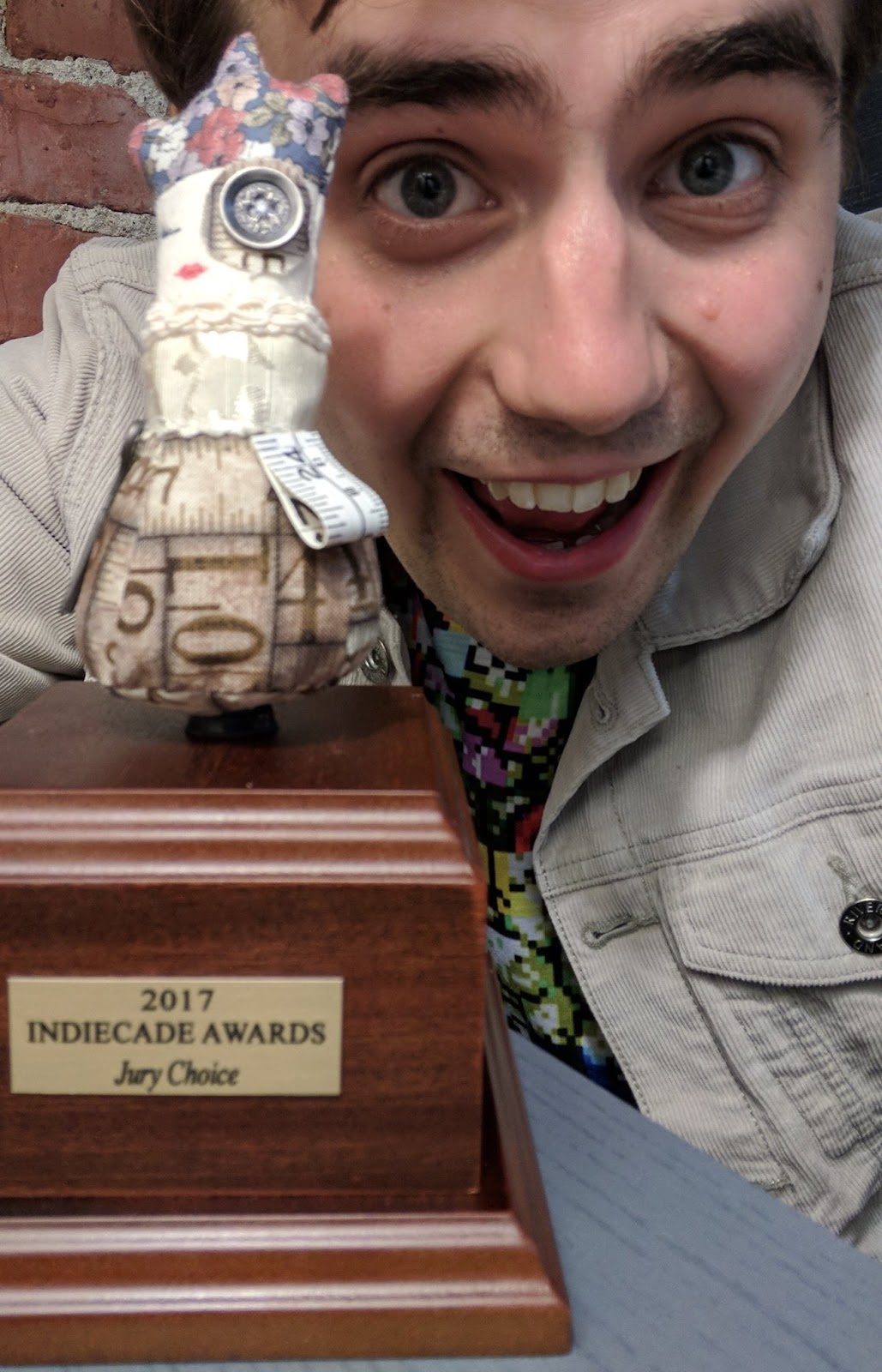
My 2017 was all about The Incredible Playable Show, and what a year it’s been. I’ve performed it in Sweden, Belgium, and Germany, and it went on to win the Jury Choice Award at IndieCade in Los Angeles.

It’s been incredibly rewarding, and I'm very proud of the reception it's had. I've loved creating and performing the show, so seeing audiences respond so well with it fills me with joy. In a lot of ways it's a culmination of the ideas I've been exploring throughout my career so far, and one of my favourite things I've made.

I wanted to wrap up the year by writing down the lessons I’ve learned along the way. This is a very long article, cut down from a leviathan first draft, so bring a coffee or read it in parts, and thanks very much for taking an interest!

For context, here’s the trailer shot at the Bristol Improv Theatre, in December 2016.


If there’s one major lesson I’ve found in the show it’s to be unafraid of things breaking. Often the lessons came out of changing part of the show on a whim, or to figure out why part of it wasn’t working - and understanding why the changed worked only came from comparing all the attempts that led up to it. None of the lessons learned came because I got things right first time.

But before getting onto that, let’s start with the most important question:

Monday, 20 November 2017

Nintendo Hard

When developing games for the NES, Nintendo designers used to have a concept of Nintendo Hard. Most kids didn’t have a lot of pocket money and games were expensive in the Eighties, so Nintendo wanted to ensure their games stood out as good value for money that provided a lot of play-time. To do this, they didn’t just make games hard; they made them Nintendo Hard. They’d do the normal three difficulty levels - Easy, Medium, Hard - and then they’d make a fourth difficulty called Nintendo Hard which was too hard for the developers to beat. Then they’d just shift everything down a space in the menu. So Easy would actually be Medium, Medium would actually be Hard, and Hard would actually be Nintendo Hard. So was the genius of Nintendo.

The above story is absolute rubbish.

There’s a thousand reasons why it makes no sense. Indeed, one of the things that makes Nintendo’s first party games stand out from other games from the same era is how intuitive, accessible and forgiving they are.

But it was told to me in a pub by a drunk guy who was very insistent and I think he liked the idea that he was imparting valuable knowledge to a so-called professional game developer. Who am I to take that joy away from him?

Thus, this is an article about what it really means to be Nintendo Hard.

Monday, 13 November 2017

Winner: IndieCade 2017 Jury Choice Award

The past few months have certainly been busy! I flew to Japan to show Codex Bash at Tokyo Game Show, followed by a trip to IndieCade in Los Angeles to perform The Incredible Playable Show, and then after a couple of weeks off I was in the air again, on my way to Hamburg to perform at Play17.

The big big news is that The Incredible Playable Show was awarded the Jury Choice Award at IndieCade 2017!

The Jury Choice Award is eligible by all games chosen for the Official Selection, and is voted on by the judges, jury and production team of the festival.

The Incredible Playable Show was part of the Night Games selection, exhibited on the second night of the festival. I was allocated the main lecture theatre to perform in, and a window of four hours. Having flown over 5000 miles to be there I thought I should make the most of it, and did three one-hour shows. I'm glad I did, as the audience were really up for it, loads of people came to see it and honestly the show was the wildest and funniest it has ever been.

In fact, I was so buzzed from performing that I only slept two hours the following night!

It really is an honour to receive the award and I'm so happy that the team at IndieCade were so impressed by it. The Incredible Playable Show is something that I have worked very hard on - it's brought together everything I've learned from all the previous games I've made, but has also challenged me to learn performance skills and fearlessness. It's a piece of work I'm very proud of and so to know that people have been so entertained by it means that that work has paid off.

Photo from @seraphki on Twitter 
I'd like to send a massive thank you to the IndieCade team for the award, and also to all the staff and stewards, the sound desk operators and the Japanese American National Museum for the fantastic venue - my work can often be complicated to set up and run, so having so many helpful people behind you helping accommodate it makes a massive difference!

I'd also like to send a massive thank you to everyone in the audience who came along, who joined in the games, who made lots of noise, who told their friends about it, and who simply enjoyed the show. Having an audience who is excited to get stuck in is what makes the show work, and so I really do mean it when I say you made it a success.

Monday, 11 September 2017

Tokyo, Los Angeles, Bath, Hamburg!

Lots of exciting announcements, and a very busy end of the year ahead for this game developer!

Tokyo


This Thursday I'll be jetting my way to Japan for Tokyo Games Show. Codex Bash has been selected for the Indie Game Area and will be playable at booth A36 from 21 - 24 September.

Los Angeles


Then in October I'll be making my return to IndieCade in Los Angeles, where The Incredible Playable Show is an Official Selection. I'll be performing as part of the Night Games event on Saturday 7 October. I'll also be giving a talk about the creation of the show at 12 noon on Sunday 8 October.

Bath


Closer to home, I'll be performing The Incredible Playable Show in Bath as part of Bath Digital Festival, at 7pm on Tuesday 17 October. Entry is free with a festival ticket, which can be purchased here.

Hamburg


Finally, November sees me returning to PLAY Festival in Hamburg, where I'll be running The Incredible Playable Show from 2 - 4 November, in Markethalle Hamburg. I'll also be performing a special surprise skit at the opening party, for audience members who like to give their vocal cords a good workout!

Tuesday, 25 July 2017

Codex Bash Selected for Out Of Index 2017

More exciting news! Codex Bash has been chosen for the Out Of Index 2017 Official Selection in Seoul, South Korea.


Out Of Index is an annual festival of experimental independent games, with a mission statement of exposing unusual and surprising works and making them visible and available to a wider audience. 98 games were submitted to the selection from a grand total of 22 countries, of which 12 made the final shortlist.

The exhibition will be this Saturday 29 July, and it marks the furthest Codex Bash has travelled from its birthplace in Bristol - narrowly beating Los Angeles by a mere 200 miles!

The developer presentariona can be live-streamed at 9am BST on the Out Of Index Twitch channel

Friday, 7 July 2017

Breaking Sonic 2: The Marathon

Earlier in the year I gathered together some friends to try to beat as much of Sonic the Hedgehog 2 (1992, Sega Mega Drive) as we could using some of my hardware and software hacks. We didn't get very far, but it was a lot of fun!

Four players, one controller


First off we tried using the Mega Cooperator - a four button co-operative controller where each player controls one of the Mega Drive's buttons. The buttons change what they do every thirty seconds and the only way to find out what they do is to press them!


Part 1: Emerald Hill Zone
Part 2: Chemical Plant Zone
Part 3: Aquatic Ruin Zone
Part 4: Casino Night Zone

I love way the kit forces everyone to communicate with each other. You need to listen as well as speak, wait as well as act, and unlike Codex Bash - my codebreaking installation which I adapted the hardware from - you have to act in tandem.

Jumping between moving platforms, for example, requires a lot of attention to what the other player is doing. Are they running fast? Are they tapering their speed?

When the game breaks as you play

Then we tried to do the same with the self-glitching emulator I made. I set up a script in the emulator to glitch random bytes of level data every time Sonic collected a ring.

We skipped around levels this time to see what other effects could come up.


I love the way this setup forces you to play the game differently. You play to avoid rings rather than collect rings, and sometimes you have to abuse the way the game's physics work to launch yourself over level geometry that was never meant to be there.

Wednesday, 28 June 2017

Homunculus - Lyst Summit 2017

Earlier in the month I was at Lyst Summit in Copenhagen. While I was there I worked on a playful performance called Being There, which I’ve talked about in an earlier blog post.

At the same time, this happened…


I say “happened,” because unlike the other games made during the weekend, Homunculus emerged practically fully-formed.

The rules of Homunculus are simple. A participant dons a morphsuit and becomes the homunculus. The player closes their eyes, while a volunteer chooses a “pleasure point” on the homunculus - a hand or an elbow, for example, or an ear. All other parts of the homunculus’ body are “pain points.” I call this “programming” the homunculus.

The player opens their eyes, and must find the pleasure point by touching bits of the homunculus’ body. The homunculus must, through physical movement alone, convey whether the point they have touched is a pleasure point or a pain point.

As you can hopefully see from the video the experience is both awkward and hilarious! Witness, for example, Sabine Harrer (PhD student and member of Copenhagen Game Collective) in stitches watching a player grope around for a pleasure point on a homunculus’ belly.


Wednesday, 21 June 2017

Being There: An Interactive Performance for Lyst Summit

A couple of weekends ago I flew to Copenhagen to take part in Lyst Summit, a symposium and game jam about love, sex and romance in video games. During the event roughly forty creatives from disciplines inside and outside games collaborated to make experimental games and playful experiences.

I teamed up with Maya Magnat, a performance artist from Tel Aviv, and Anders Børup, a sound designer from Copenhagen, to create Being There - an audio-led role-play for two people.

About Being There


Being There is played by two participants, who each take a headset loaded with an audio track. The two participants start the audio at the same time, and have to follow the actions described to them by the audio. The two tracks start similar, but over time the perspective offered by the two narrators changes. One participant’s view of the events will become increasingly different to the other’s.

The story that participants act out is the story of a relationship from first date to break-up.

If you want to try the prototype version we made during Lyst, the mp3 files are below for you to download and try out. And below them, a bit of an explanation and discussion of the process, if you don’t mind the magic being spoiled!

You will need to hug, hold hands, and have your phone on you to take a photo with.

Download: Participant A
Download: Participant B

The voices are provided by myself, and by writer Jordan Erica Webber.


Monday, 5 June 2017

How Sonic the Hedgehog Uses Colour

There’s a lot of excellent use of colour in the very first Sonic the Hedgehog game on Sega Mega Drive.

Visual readability has been a personal bugbear throughout my time in video games. There’s been some cases where I’ve been really happy with the choices I’ve made, and others where I feel I could have done much better. From my point of view, visual design is only partly about making things look pretty. It is primarily about conveying information that the player needs in order to interact.

Where are the key objects in the scene? What do they do? What can I interact with? How can I interact with it? What is my goal? What should I aim to avoid? Once those questions have been answered, then the developer is free to answer the question “how should I feel about this scene?”


The original Sonic the Hedgehog is visually outstanding not just because it presents landscapes that feel rich, vivid and fleshed out, but also because it has a very strong grasp on delivering key information. I’ve always admired, for example, the fact that Sonic when rolling is the exact same shape as his hit-box

Sonic the Hedgehog conveys its information not just through the shape and form of its visual elements, but also by its use of colour. That’s what makes it an exciting example I want to explore in this article.